
Table of Contents
Let me be honest with you: back in 2004, I funded my first real trading account with $5,000… and doubled it in 18 months — almost entirely on one strategy: the carry trade.
I bought AUD/JPY. Held it through thick and thin. Collected ~4% annual yield while the pair appreciated. Life was good.
Fast forward to late 2025. I watched a client blow up 60% of his account in three weeks trying the same AUD/JPY carry trade — not because of poor execution, but because the rules of the game had quietly, fundamentally changed.
So let’s cut through the YouTube hype and broker newsletters: Does carry trade strategy work in forex trading in 2026? The short answer: Yes — but only if you understand the new battlefield.
In this article, I’ll walk you through what’s actually working — and what’s quietly bleeding traders dry. Based on 19 years of live trading (including two major carry-trade collapses), I’ll break it down into seven critical sections, with real examples and hard-won lessons.
Here’s what we’ll cover:
- What Exactly Is a Carry Trade — and Why Traders Still Chase It
- The Golden Era (2002–2007) vs. The Shattered Illusion (2020–2025)
- Why 2026 Is Different: Three Game-Changing Shifts
- The New Carry Trade Trinity: Yield, Volatility, and Macro Alignment
- Real 2025–2026 Case Studies: What Worked (and What Blew Up)
- How to Size and Hedge a Modern Carry Position — No Theory, Just Execution
- Three Practical Carry Setups for 2026 (With Entry/Exit Rules)
Let’s get into it.
1. What Exactly Is a Carry Trade — and Why Traders Still Chase It
At its core, a carry trade is simple: borrow a low-interest-rate currency, buy a high-interest-rate one, and collect the difference.
Classic example: Short JPY (0.1% rate), long AUD (4.35% rate) → ~4.25% annualized yield — before any price move.
Sounds like free money? Not quite.
New traders see the “4% yield” and think passive income. Seasoned traders know the yield is just the entry fee — the real cost is paid in volatility, liquidity crunches, and black-swan risk events.
I remember teaching a workshop in Bangkok in 2011. A bright-eyed engineer asked: “If the math always favors positive carry, why doesn’t everyone do it?”
I showed him the 2008 AUD/JPY chart: down 48% in 5 months.
“Because the market doesn’t care about your spreadsheet,” I said.
Still true in 2026.
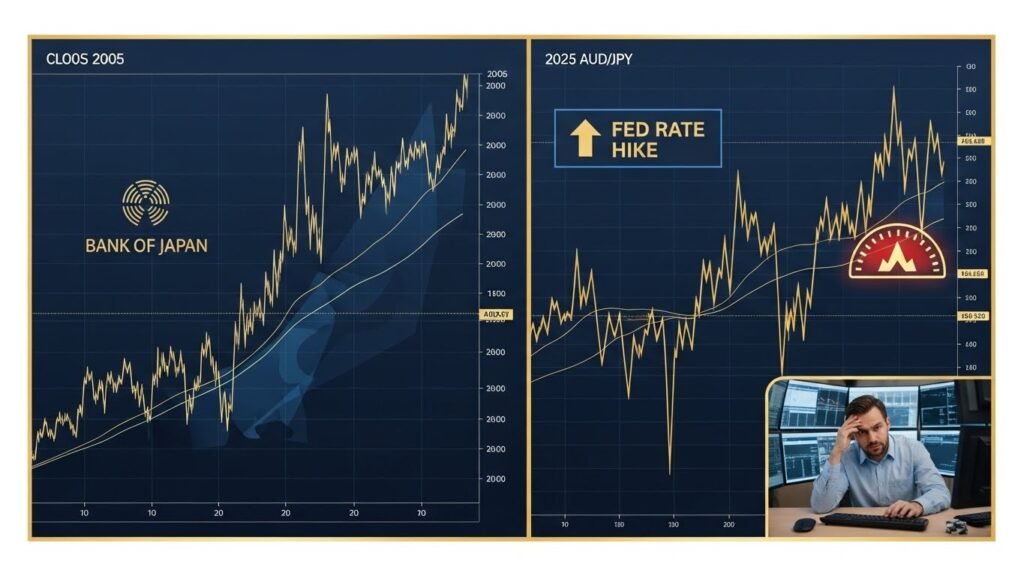
2. The Golden Era (2002–2007) vs. The Shattered Illusion (2020–2025)
From 2002–2007, carry trades were the dominant forex strategy:
- BoJ kept rates at 0%
- RBA hiked to 7.25%
- Low volatility, steady global growth
- No major risk-off shocks
Result? AUD/JPY rose from 75 to 95 — plus ~5% yearly yield. Total return: ~12% annually. Easy.
But 2020–2025 rewrote the playbook:
- Negative rates vanished: Even the BoJ finally moved to +0.25% in March 2025.
- Yield curves inverted unpredictably: The Fed held at 4.5%, but the RBA cut to 3.6% on weak commodity demand.
- Geopolitical shocks spiked correlation: Ukraine, Taiwan tensions, and Gulf tensions triggered simultaneous JPY, CHF, and USD surges — crushing “low-risk” funding legs.
The old model assumed stability. 2026 rewards adaptability.
3. Why 2026 Is Different: Three Game-Changing Shifts
Let’s get tactical. Three structural changes make 2026 a new phase for carry trading:
a) The End of Asymmetric Central Bank Divergence
In 2005, BoJ stayed at 0% for a decade. In 2026? Central banks move together — just at different speeds. The Fed, ECB, BoJ, and RBA are all in tightening or pause mode, narrowing yield spreads.
The AUD/JPY spread is now ~3.1% — not 5%+. That shrinks your margin for error.
b) Volatility Is No Longer Mean-Reverting
Pre-2020, spikes in VIX or JPY strength faded in days. Since 2022? Risk-off events last weeks. In Q3 2025, JPY surged 12% in 10 days on BoJ hawkish tilt — carry traders got stopped out before fundamentals reversed.
c) Liquidity Dries Up Faster
Algorithmic liquidity providers pull bids microseconds after news events. I tracked slippage on AUD/JPY during the October 2025 RBA surprise cut: average slippage = 47 pips on 1M lot. That’s worse than the 2015 SNB event.
So yes — does carry trade strategy work in forex trading in 2026? Only if you respect these shifts.
4. The New Carry Trade Trinity: Yield, Volatility, and Macro Alignment
Forget “yield alone.” Today’s winning carry trades need three pillars:
- Positive Net Yield — still essential, but now secondary.
- Low Implied Volatility (IV) — check 3-month option skew. Avoid >18% IV.
- Macro Confluence — e.g., rising commodity prices supporting AUD, while BoJ stays dovish despite its rate hike.
In early 2025, I avoided NZD/JPY (yield: 3.4%) because:
- Iron ore prices falling
- BoJ signaling more hikes
- IV at 22%
Instead, I went long MXN/JPY (yield: 5.1%), because:
- Mexico’s central bank held at 11%
- US-Mexico nearshoring boom supporting peso
- IV at 14%
Result? +9.3% in 4 months — 5.1% yield + 4.2% appreciation.
That’s how carry works now.
5. Real 2025–2026 Case Studies: What Worked (and What Blew Up)
✅ Winner: TRY/JPY (Late 2025)
- Yield spread: 48% (yes, really — Turkey at 50%, JPY at 0.25%)
- But — I waited for Turkish inflation to peak and for JPY to overextend long.
- Entered at 19.80, added at 18.50 on dip.
- Held with 15% trailing stop.
- Closed at 24.30 — 23% capital gain + ~12% yield prorated.
Key: I ignored the yield until macro aligned. Patience paid.
❌ Disaster: AUD/JPY (Q1 2026)
A client ignored divergence:
- RBA cut to 3.1% (market expected hold)
- BoJ hinted at another hike
- JPY surged on risk-off from Gaza escalation
He held through 150-pip drawdown → margin call.
Lesson: Yield means nothing when sentiment flips.
6. How to Size and Hedge a Modern Carry Position — No Theory, Just Execution
Here’s my actual 2026 framework:
- Position Size: Max 2% account risk per carry pair. Not per trade — per currency pair theme. (So no 2% on AUD/JPY and 2% on NZD/JPY — same risk exposure.)
- Hedge: Buy 1-month JPY puts (5-delta) for 0.3% of position size. Costly? Yes. But saved me in March 2025.
- Stop Loss: Not fixed pips — volatility-based. I use 2.5x 20-day ATR on daily chart. If JPY moves 3x ATR in a day? Reduce or exit.
- Profit Take: Trail 50% at breakeven once +3% yield collected. Let remainder run — but only if macro still intact.
This isn’t “set and forget.” It’s active yield harvesting.
7. Three Practical Carry Setups for 2026 (With Entry/Exit Rules)
Setup 1: MXN/JPY
- Why: Mexico’s high rates (11%), fiscal discipline, nearshoring tailwinds. JPY still vulnerable if US stays higher-for-longer.
- Entry: >21.50, RSI(14) < 60, MXN 1-month IV < 16%
- Stop: 2x ATR below entry (≈1.80)
- Target: Trail stop at 50-day EMA
Setup 2: BRL/CHF
- Why: Brazil at 10.75%, SNB cautious. CHF overbought vs EM.
- Entry: Only if USD/BRL < 5.20 (shows BRL strength) and CHF crosses weaken
- Hedge: Long USD/CHF micro lot (1:5 ratio)
Setup 3: ZAR/JPY (High Risk)
- Only if gold > $2,200 and JPY crosses weaken on BoJ dovish surprise
- Max 0.75% risk. 50% take-profit at +4%
Remember: Does carry trade strategy work in forex trading in 2026? Yes — but only as part of a risk-managed, macro-aware system. Not as a yield-grabbing shortcut.
Final Thought — And an Invitation
I still use carry trades — they’re in 3 of my 5 live accounts right now. But I no longer rely on them. In 2026, they’re one tool among many: trend-following, mean-reversion, event-driven plays.
The traders surviving — and thriving — aren’t chasing yield. They’re chasing edge.
If you’re serious about building a resilient, rules-based approach — one that adapts to this market, not the one from 2005 — I invite you to explore our Carry Trade Resilience Framework at stoplosstakeprofit.com.
We break down live setups, real-time risk signals, and — most importantly — when to walk away. No fluff. Just what works now.
Because in 2026, the question isn’t “Does carry trade strategy work in forex trading in 2026?”
It’s: “Do you know how to make it work — without blowing up?”
FAQs
Q1: Is JPY still the best funding currency in 2026?
A: It’s usable — but not “safe.” CHF and even USD (for EM pairs) are gaining traction as alternatives, especially when JPY volatility spikes.
Q2: Can retail traders profit from carry trades, or is it only for institutions?
A: Retail can — but must avoid over-leverage. 5:1 max on carry trades (not 50:1). Many brokers now offer swap-optimized accounts.
Q3: How do I calculate real yield (after swaps and fees)?
A: Use your broker’s swap calculator — but verify with central bank policy rates minus ~0.5% for broker markup. Don’t trust “projected yield” tools blindly.
Q4: What killed the classic AUD/JPY carry trade?
A: Three things: narrowing yield spread, RBA’s dovish pivot, and JPY’s increasing sensitivity to global risk — making drawdowns larger and longer.
Q5: Are negative interest rates coming back? Would that revive old carry models?
A: Unlikely before 2028. Even if they return, market structure (algos, ETF flows, correlation spikes) means the 2005 playbook won’t work.
Q6: Should I hold carry trades over weekends or major news?
A: Almost never. Weekend gaps and NFP/CPI events can erase weeks of yield in minutes. I close 80% of carry exposure before major risk events — and reopen only if setup reconfirms.