
Table of Contents
If you’ve spent time trading forex, crypto, indices, or stocks, you’ve probably noticed that markets don’t move in straight lines. They push, pull back, test levels, and continue their trend. That’s why traders keep asking me one important question:
“How do I know where the pullback might end?”
For more than 10 years of my trading journey, one tool has consistently helped me predict pullback zones with surprising accuracy: Fibonacci Retracements.
And today, many traders want to know How to Use Fibonacci Retracements in 2026, especially as market conditions evolve, algorithms become more active, and liquidity behavior shifts.
In this article, I’ll show you how professionals use Fibonacci retracement levels, why they still work in 2026, and how you can apply them with confidence — using real examples based on price behavior I see every week.
By the end, you’ll know how to identify perfect entries, avoid fake pullbacks, and combine Fibonacci with other tools for stronger confirmation.
1. Understanding What Fibonacci Retracements Are (Without the Complicated Math)
You don’t need to be a mathematician to understand Fibonacci.
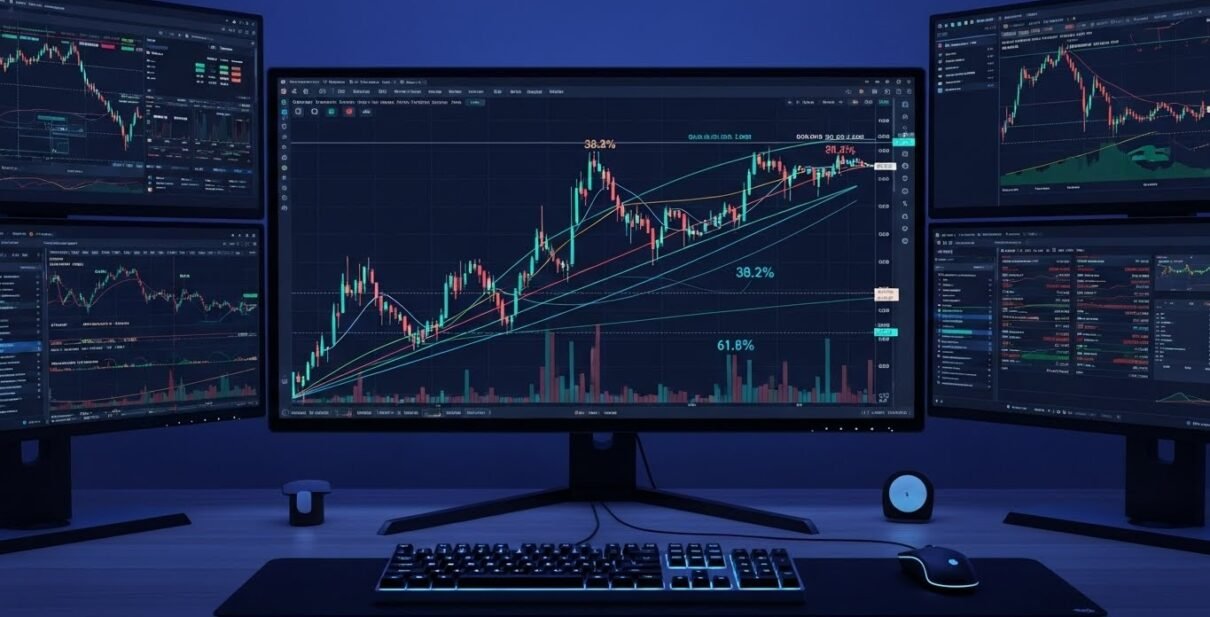
In trading, Fibonacci retracements are simply horizontal price levels that show where price is likely to pull back before resuming its trend.
The key Fibonacci levels traders use are:
- 23.6%
- 38.2%
- 50% (not a true Fibonacci number, but highly respected)
- 61.8% (the “Golden Ratio”)
- 78.6%
These levels show how far price might retrace before continuing its original move.
If you want to understand How to Use Fibonacci Retracements in 2026, start with this idea:
Fibonacci levels work because smart money uses them — and retail traders react to them.
That combination keeps them relevant, year after year.
2. Why Fibonacci Retracements Still Work in 2026
Some traders believe indicators stop working as markets evolve. But after years watching price behavior, I can confidently say Fibonacci remains extremely accurate.
Here’s why Fibonacci still works in 2026:
1. Algorithms Use Fibonacci Data
Modern trading bots and institutional algorithms use Fibonacci-based logic to detect retracement levels, which reinforces the levels even further.
2. Human Psychology Doesn’t Change
The market is still driven by fear, greed, uncertainty, and hesitation. Pullbacks follow patterns because people react in predictable ways.
3. Price Always Needs to Breathe
Even in fast markets, price cannot move in a straight line forever. Pullbacks form structure — and Fibonacci helps you measure that structure.
4. Works in All Market Conditions
Trending markets
Ranging markets
News-driven markets
Even choppy sessions — Fibonacci helps define possible turning points.
These reasons are exactly why traders keep asking How to Use Fibonacci Retracements in 2026 to sharpen their entries.
3. How to Draw Fibonacci Retracements Correctly
One of the biggest mistakes traders make is drawing Fibonacci incorrectly.
Here’s the correct way:
Step 1 — Identify Clear Trend Direction
You must know whether the market is:
- trending up
- trending down
- or ranging
Using Fibonacci in a range gives poor results.
Step 2 — Use Accurate Swing Points
In an uptrend:
Draw Fibonacci from the low (swing low) to the high (swing high).
In a downtrend:
Draw Fibonacci from the high (swing high) to the low (swing low).
Accuracy matters — even a small mistake offsets all levels.
Step 3 — Wait for the Market to Retrace
Price will often pull back to one of the major levels:
- 38.2%
- 50%
- 61.8%
These are the most probable entry zones.
If you want to master How to Use Fibonacci Retracements in 2026, practice drawing levels cleanly. Using random highs and lows leads to confusion.
4. Understanding Each Fibonacci Level (And When to Trade Them)
Different Fibonacci levels behave differently. Let me break down how I personally use each one after many years of watching charts.
23.6% — Shallow Pullback
Used in strong trends.
If price only hits 23.6% and continues, it shows very strong momentum.
38.2% — Trend Continuation Level
Common in healthy uptrends or downtrends.
This is the level I target when market structure is strong.
50% — The Classic Pullback Zone
Traders love the 50% level.
Even though it isn’t a Fibonacci number, smart money respects it.
You’ll see price bounce off this level hundreds of times on major pairs like EURUSD, GBPUSD, and XAUUSD.
61.8% — The Golden Ratio
This is the most powerful retracement level.
Price often:
- reverses sharply
- forms double bottoms
- forms double tops
- creates aggressive breakouts
Learning How to Use Fibonacci Retracements in 2026 means mastering the 61.8% zone — it remains the most traded level today.
78.6% — Deep Pullback Level
Signals a potential trend reversal or a very deep correction.
High risk but high reward.
5. Combining Fibonacci With Market Structure (My Favorite Approach)
Fibonacci works best when used with structure.
Here’s how I combine them:
1. Support and Resistance
If Fibonacci 61.8% aligns with a strong support level, I call it “confluence.”
The probability of reversal is extremely high.
2. Trendlines
When a trendline meets a Fibonacci level, I wait for a wick rejection — this often leads to explosive moves.
3. Moving Averages (MA50 and MA200)
When an MA crosses a Fibonacci level, it creates a zone institutions respect heavily.
4. Order Blocks
Fibonacci becomes even stronger when it matches an institutional order block.
This is the method I use every week, and it’s why traders want to know How to Use Fibonacci Retracements in 2026 with modern price-action strategies.
6. Real Examples From My Trading Experience
To make Fibonacci practical, let me share real examples from my charts.
Example 1 — EURUSD Uptrend
Price created a new high.
I plotted Fibonacci from low to high.
Retracement hit the 38.2% level perfectly, rejecting with a bullish pin bar.
I entered long and rode the next move upward.
Example 2 — Gold (XAUUSD) Pullback
During a strong news-driven uptrend, gold retraced deeply.
The 61.8% level aligned with a previous support zone.
Volume increased.
I took the buy — price surged $30 afterward.
Example 3 — GBPJPY Downtrend
In a bearish trend, Fibonacci mapped a pullback toward the 50% level.
Price rejected with a strong bearish engulfing candle.
Perfect entry.
These examples show why knowing How to Use Fibonacci Retracements in 2026 can transform your trade timing.
7. Mistakes Traders Make When Using Fibonacci Retracements
Avoid these common errors:
1. Drawing From the Wrong Points
Using incorrect swing highs/lows creates false signals.
2. Using Fibonacci in Ranging Markets
Fibonacci works best in trending markets.
3. Ignoring Candle Patterns
Price-action confirmation matters.
4. Forcing Fibonacci on Every Chart
Only use it when the trend is clear.
5. Trading Every Level Blindly
Not every Fibonacci level leads to reversals.
6. Using Too Many Indicators Together
Keep your chart clean.
Fibonacci + structure is usually enough.
Understanding these mistakes helps you fully grasp How to Use Fibonacci Retracements in 2026 with clarity and consistency.
Conclusion — Start Trading Fibonacci With Confidence
Fibonacci remains one of the most powerful tools in trading — even in 2026. Whether you trade forex, crypto, metals, or stocks, Fibonacci helps you identify where the market might pause, reverse, or continue.
Now you understand How to Use Fibonacci Retracements in 2026 the right way:
- Proper drawing
- Level interpretation
- Trend confirmation
- Confluence techniques
- Real examples
- Common mistakes to avoid
If you want more expert trading guides, risk strategies, chart breakdowns, and smart trader tools, visit:
👉 StopLossTakeProfit.com — Where serious traders sharpen their craft.
6 FAQs
1. Do Fibonacci Retracements work in all markets?
Yes — they work in forex, crypto, stocks, indices, and metals as long as a clear trend exists.
2. Which Fibonacci level is strongest?
61.8% is the most respected level across all markets.
3. Should I enter immediately when price hits a level?
Wait for confirmation such as wicks, candle formations, or volume spikes.
4. Are Fibonacci levels accurate?
They are not perfect, but with confluence they give strong probabilities.
5. Can Fibonacci help with stop-loss placement?
Yes — many traders place stops just beyond the next Fibonacci level.
6. Do professionals still use Fibonacci in 2026?
Absolutely — institutions and algorithms rely heavily on Fibonacci ratios.